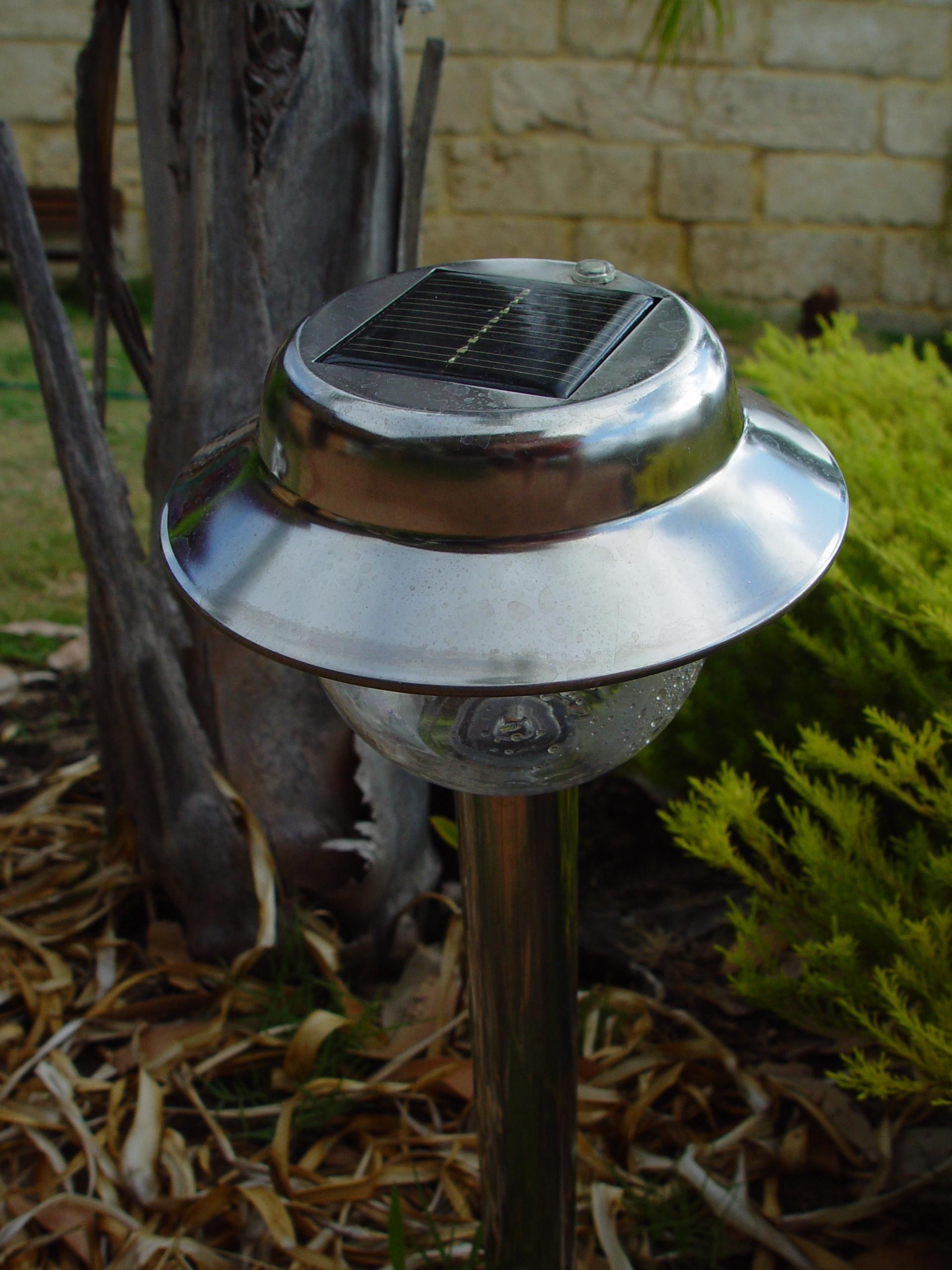
The choice between solar-powered and wired (low-voltage) landscape lighting is more consequential in Canada than in most other markets. The reason comes down to one factor: daylight hours in winter are short enough in most Canadian cities that solar panels cannot reliably charge batteries to deliver a full night of illumination during the months when outdoor lighting is most needed.
This is not a reason to rule out solar entirely. But it does change the math considerably compared to what most solar lighting manufacturers assume in their product testing and marketing.
How solar landscape lighting works
A typical solar pathway or garden light consists of a small monocrystalline or polycrystalline photovoltaic panel (usually 2–6 watts), a rechargeable battery (lithium-ion or nickel-metal hydride in most current products), an LED array, and a light sensor that activates the fixture at dusk.
The system's output depends on two variables: how much energy the panel collected during daylight hours, and how efficiently the battery retains and delivers that charge. Both variables are affected by Canadian winter conditions.
Daylight hours by Canadian city
In December, Canadian cities receive significantly fewer daylight hours than the temperate zones where most solar lighting products are tested and marketed:
- Vancouver, BC — approximately 8.5 hours of daylight on the winter solstice
- Calgary, AB — approximately 8.0 hours
- Toronto, ON — approximately 8.8 hours
- Ottawa, ON — approximately 8.6 hours
- Montréal, QC — approximately 8.8 hours
- Halifax, NS — approximately 9.0 hours
- Winnipeg, MB — approximately 7.5 hours
- Edmonton, AB — approximately 7.4 hours
In contrast, the solar irradiance during those hours is much lower than in summer — the sun sits low in the sky, panels collect at a steep angle relative to direct sunlight, and overcast conditions (common in December across much of Ontario, BC, and the Maritimes) further reduce effective collection.
A realistic collection estimate for a 5W solar panel in southern Ontario in December is 30–40% of its rated output per hour of daylight, or roughly 12–17 Wh for the day. A fixture drawing 0.5W to illuminate at moderate brightness for 10 hours of a winter night needs 5 Wh. The math holds for a single fixture on a clear winter day, but fails immediately with overcast skies or multiple consecutive cloudy days.
Battery performance in cold
Lithium-ion batteries, which are the standard in mid-range and higher solar landscape lights, lose capacity at low temperatures. At 0°C, a lithium-ion cell delivers roughly 80–90% of its room-temperature capacity. At −20°C, capacity can fall to 50–60%. At −30°C, some lithium-ion chemistries approach 30–40% of rated capacity.
This means a battery that holds 1000 mAh at room temperature may deliver only 400 mAh on a night where temperatures fall to −25°C. Fixtures that appeared adequate in October may fail to complete a full night's cycle in January.
Nickel-metal hydride (NiMH) batteries, found in lower-cost solar fixtures, perform somewhat better at low temperatures than standard lithium-ion but have lower energy density overall. Lithium iron phosphate (LFP) cells, appearing in higher-end solar products, retain better capacity at −20°C and −30°C than standard NMC lithium-ion.
Where solar works well in Canada
Solar landscape lighting is most reliable in Canada in three scenarios:
- Seasonal use only — fixtures installed for May through October and brought indoors or disconnected for winter. This works well for decorative garden features, patio lighting, and areas where winter lighting is not a functional requirement.
- Supplemental accent lighting — in locations where there is already adequate illumination (street lighting, security lights) and the solar fixture is an aesthetic addition rather than a functional requirement.
- Mild coastal climates — Metro Vancouver, Victoria, and coastal areas of BC where winter temperatures rarely fall below −10°C and solar collection in December is more reliable than in interior Canada.
Low-voltage wired systems
A wired low-voltage (12V) landscape lighting system consists of a transformer (typically 150W to 600W, mounted to an outdoor-rated box near the house), direct-burial landscape cable (typically 12 AWG or 14 AWG), and a series of fixtures tapped onto the cable run.
The transformer plugs into a standard outdoor 120V outlet and steps voltage down to 12V. Canadian Electrical Code Section 12 governs direct-burial cable requirements — most low-voltage landscape cable is rated for direct burial at 150mm or deeper. In regions with frost lines deeper than 150mm (most of Ontario, Quebec, and the Prairies), cables should be buried at or below the frost line to avoid damage from frost heave, or run through conduit.
Running costs by province
A typical low-voltage landscape system with 10 fixtures at 5W each (50W total) running 8 hours per night uses 400 Wh (0.4 kWh) per night, or roughly 146 kWh per year. At current provincial utility rates:
- Ontario (Hydro One, time-of-use mid-peak) — approximately $0.132/kWh = ~$19/year
- British Columbia (BC Hydro, Step 1) — approximately $0.0954/kWh = ~$14/year
- Alberta (average ATCO rate) — approximately $0.16–0.19/kWh = ~$23–28/year
- Quebec (Hydro-Québec, Tier 1) — approximately $0.0627/kWh = ~$9/year
- Nova Scotia (Nova Scotia Power) — approximately $0.16/kWh = ~$23/year
Annual running costs for a moderate-sized wired system are typically under $30/year across all Canadian provinces, making operating cost a secondary consideration compared to installation cost and reliability.
Which to choose
For year-round functional lighting — pathways, driveways, stairs, security perimeters — a wired low-voltage system is more reliable across Canadian climates. The upfront installation cost is higher (transformer, cable, burial) but the system performs predictably regardless of winter daylight or temperatures.
For seasonal or decorative lighting in locations where a utility outlet is not nearby, solar is a practical and low-maintenance option. The key is choosing fixtures with LFP battery chemistry and realistic expectations about winter performance.
Mixing both approaches is also common: wired systems for functional pathway and driveway lighting, solar for summer-season decorative elements in areas of the garden without easy cable access.
Related articles
Selecting outdoor lighting for the Canadian climate
Low-voltage pathway lighting: an installation walkthrough